Updated: 14 October 2026
If you have completed your Intermediate (HSSC / F.A / F.Sc / I.Com / ICS) education and you are searching for a stable, respectable government career in Pakistan, October 2026 brings an exceptional wave of opportunities. Securing a government job (BS-05 to BS-15) right after intermediate is one of the smartest career moves you can make—offering job security, medical allowances, pension benefits, and clear promotion pathways without requiring a multi-year university degree.
Across federal ministries, provincial public service commissions (PPSC, FPSC, KPPSC, SPSC), railways, postal services, district courts, and autonomous corporations, hundreds of intermediate-level vacancies are currently open or announced for application in October 2026.
This comprehensive guide puts everything you need in one place. You will discover the types of intermediate-level government jobs available, department-wise eligibility criteria, age relaxations, step-by-step application instructions, essential document checklists, typing test standards, common application pitfalls to avoid, and a proven 5-step test preparation strategy to guarantee your success.
Important Note: Recruitment announcements, vacancy quotas, and deadlines are updated regularly by respective federal and provincial departments. Always verify the official advertisement on the issuing commission or department’s website before submitting your documents or application fee.
Quick Summary: Intermediate Government Jobs in Pakistan (October 2026)
Here are the key facts and takeaways before diving into the complete blueprint:
- Target Qualification: Intermediate (F.A, F.Sc, ICS, I.Com, DAE) or equivalent 12-year education.
- Typical Pay Scales: BPS-05 to BPS-15 (Junior Clerks, Data Entry Operators, Stenographers, Sub-Inspectors, Assistants).
- Major Hiring Bodies: Federal Public Service Commission (FPSC), Punjab Public Service Commission (PPSC), Khyber Pakhtunkhwa ETEA & KPPSC, Sindh Public Service Commission (SPSC), and various federal ministries.
- Application Mode: Primarily online via official portals, with challan submission through 1Link 1Bill or designated banks.
- Key Skills Required: Basic IT literacy (MS Office), typing speed (for clerical posts), shorthand (for stenographers), and general ability test preparation.
For related guidance on preparing your resume and verifying your qualifications, explore our free online resources including the ATS Bio Data Maker and Job Document Resizer.
Why Intermediate-Level Government Jobs Are in High Demand
Every year, hundreds of thousands of students graduate from higher secondary school boards across Pakistan. While university degrees are valuable, competition for graduate-level (BS/Master’s) CSS or PMS posts is intensely fierce. In contrast, intermediate-level government jobs (often categorized as clerical, administrative, and junior executive roles) offer several distinct advantages:
- Early Career Stability: You enter the professional workforce years earlier, gaining valuable government service seniority and departmental experience in your early twenties.
- Departmental Promotions: Most government departments offer internal departmental promotional exams (DPE) and time-scale promotions, allowing intermediate-pass employees to rise to higher gazetted officer ranks over time.
- Broad Skill Applicability: Roles such as Junior Clerk, Assistant, Computer Operator, and Data Entry Operator exist in virtually every government office, ensuring massive and continuous recruitment cycles across federal and provincial tiers.
- Balanced Work-Life Integration: Unlike unpredictable private sector jobs, government service provides fixed working hours, medical coverage, leaves, and post-retirement security.
Major Categories of Intermediate Government Jobs
Intermediate-level vacancies span across multiple government tiers. Depending on your academic background (Pre-Medical, Pre-Engineering, ICS, or Arts/Commerce), you can target different specialized domains:
1. Administrative and Clerical Cadres
These are the most common government positions, open to candidates from any intermediate background:
- Junior Clerk (BPS-11): Responsible for file management, inward/outward correspondence, and basic record keeping. Usually requires a typing speed of 30 words per minute.
- Senior Scale Stenographer / Stenotypist (BPS-14 / BPS-12): Requires proficiency in shorthand and typing (typically 70/80 wpm shorthand and 35/40 wpm typing). Highly sought after in secretariats, courts, and commissioner offices.
- Assistant / Upper Division Clerk (UDC – BPS-11 to BS-15): Involves supervisory office management, noting and drafting summaries, and correspondence handling.
2. Technical & IT Support Roles (Ideal for ICS & DAE Graduates)
- Data Entry Operator (DEO – BPS-12/14): Involves database management, fast computer data entry, and digital record keeping.
- Computer Operator (BPS-16): Often requires a 2-year bachelor’s degree or strong intermediate IT qualifications with rigorous typing and software proficiency tests.
- Sub-Engineer (Civil/Electrical – BPS-11/14): Requires a Diploma of Associate Engineering (DAE) in the respective discipline from a recognized board of technical education.
3. Uniformed & Law Enforcement Services
- Police Constable / Assistant Sub-Inspector (ASI): Many provincial police departments hire intermediate-pass candidates for constable (BPS-07) and ASI (BPS-11) posts, subject to strict physical and medical standards.
- Excise, Taxation & Narcotics Control Inspectors: Administrative and field enforcement roles requiring intermediate qualifications and physical fitness.
Complete Overview of Open Sectors & Departments (October 2026)
To help you navigate October 2026’s active job market, here is a structured breakdown of the primary government departments hiring intermediate candidates:
| Department / Commission | Target Posts | Scale (BPS) | Key Qualification | Domicile / Jurisdiction |
|---|---|---|---|---|
| Federal Ministries via FPSC | Assistants, Ministerial Clerks, Statistical Assistants | BPS-11 to BS-15 | Intermediate / Bachelor’s | Federal / All Pakistan Quota |
| PPSC (Punjab Public Service Commission) | Junior Clerks, Stenographers, Revenue Patwaris | BPS-09 to BS-14 | Intermediate with Computer Literacy | Punjab Domicile |
| ETEA / KPPSC (Khyber Pakhtunkhwa) | Fire Rescuers, Junior Clerks, Health Technicians | BPS-07 to BS-12 | F.Sc / Intermediate / DAE | KP Domicile |
| District & Civil Courts (Punjab/KP) | Junior Clerks, Computer Operators, Stenographers | BPS-11 to BS-16 | Intermediate + Typing Speed | District / Division Specific |
| Railways & Postal Services | Booking Clerks, Sorting Assistants, Office Assistants | BPS-07 to BS-11 | Intermediate / F.A / F.Sc | Regional / Pakistan Railways Quota |
If your academic transcripts report CGPA instead of standard marks or divisions, you can easily convert your grades using our free CGPA to Percentage Calculator before filling out your application.
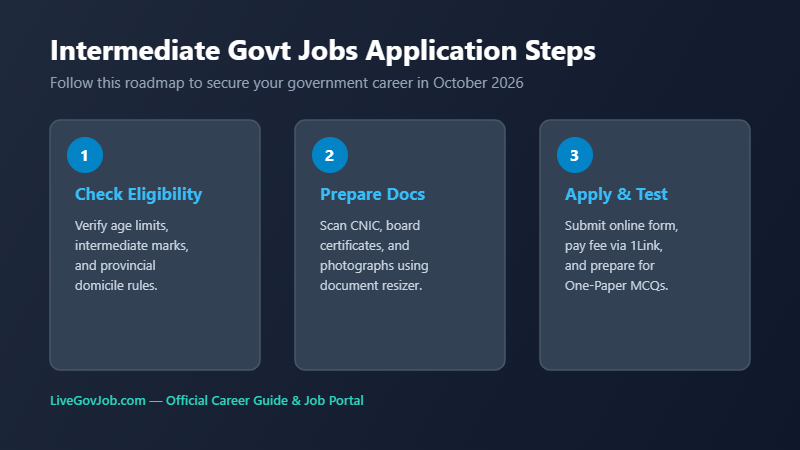
Step-by-Step Guide: How to Apply for Intermediate Government Jobs
Applying for government positions requires meticulous attention to detail. Skipping a step or missing a deadline results in instant disqualification. Follow this proven sequence:
- Find Verified Advertisements: Regularly check official job portals such as PPSC (
ppsc.gop.pk), FPSC (fpsc.gov.pk), ETEA, or national newspapers (Jang, Dawn, Express). Beware of unofficial or fake recruitment sites. - Review Eligibility Criteria Thoroughly: Check the exact age limits (usually 18 to 25 or 30 years, with general age relaxations provided by provincial and federal governments), required academic division, and specific skill requirements (such as typing speed certificates).
- Prepare Digital Scans: Keep your scanned CNIC (front and back), recent passport-size photograph with white/blue background, and intermediate certificate ready. If file sizes exceed portal limits, use our free Job Document Resizer tool to compress them instantly without losing clarity.
- Fill Out the Online Application: Register on the respective commission’s portal using your active mobile number and valid CNIC. Enter your educational history, starting from Matric up to Intermediate, ensuring passing years and total marks match your board certificates.
- Generate and Pay Fee Challan: Download the application fee challan. Pay the required non-refundable fee (usually PKR 300 to PKR 1,000 depending on the post) through designated bank counters, ATMs, or mobile banking apps via 1Link 1Bill.
- Finalize and Submit: Enter your transaction/receipt ID on the portal, review your application summary, and submit. Print out the final application confirmation slip for your records.
Essential Documents to Keep Ready
While online applications only require digital uploads initially, you must keep physical copies of all credentials verified and organized for subsequent typing tests, interviews, and document verification stages:
- Original CNIC: Valid National Identity Card issued by NADRA.
- Matriculation (SSC) & Intermediate (HSSC) Certificates: Detailed mark sheets (DMCs) and board-issued passing certificates confirming your 12-year education.
- Domicile & PRC: District domicile certificate and Permanent Residence Certificate (PRC).
- Computer / Typing Certificate (if required): Certified proof of typing speed or IT proficiency from a recognized institute (e.g., PBTE).
- Recent Photographs: Multiple passport-size studio photographs.
- Fee Payment Receipt: Stamped bank challan or digital transaction confirmation slip.
Common Mistakes That Cost Candidates Their Jobs
Thousands of applicants fail to clear the initial screening or get disqualified during document verification due to simple, avoidable errors:
- Waiting Until the Last Day: Portal servers and bank networks experience severe congestion in the final 48 hours of any application deadline, often preventing successful fee verification.
- Incorrect Academic Data: Entering wrong marks, incorrect board names, or mismatched passing years triggers automated disqualification by screening software.
- Ignoring Age Limit Calculations: Always check the exact date from which age is calculated (e.g., “as of 1 January 2026”). Being even one day over the age limit without eligible relaxation voids your application.
- Neglecting Typing Practice: For clerical and stenography posts, candidates often pass the written test but fail the mandatory typing speed test because they practiced lazily.
- Trusting Fraudulent Agents: Government hiring through PPSC, FPSC, and official boards is entirely merit-based. Anyone claiming they can secure a job or leak test papers for money is a criminal scammer.
How to Prepare for Intermediate-Level Tests
Most intermediate-level government recruitment follows a standard One-Paper MCQs Screening Test conducted by testing bodies (PPSC, FPSC, OTS, PTS, etc.). Here is a practical, 5-step preparation strategy:
Step 1: Analyze the Syllabus
Download the syllabus or paper pattern provided in the job advertisement. Standard intermediate-level tests typically comprise:
- English: Grammar, vocabulary, sentence completion, synonyms, antonyms (20%).
- Urdu: Basic grammar, poetry terms, sentence correction (20%).
- General Knowledge & Pakistan Studies: Geography, history, important personalities, Islamic studies (20%).
- Basic Mathematics: Arithmetic, percentages, ratios, averages, basic algebra (15%).
- Everyday Science & Computer Knowledge: Basic hardware, MS Office (Word, Excel, PowerPoint) shortcuts, operating systems (25%).
Step 2: Build a Consistent Daily Study Routine
Dedicate 2 to 3 hours every day to focused preparation. Avoid cramming all your study hours into a single weekend; consistency builds long-term memory retention.
Step 3: Practice Past MCQs Papers
Solve previous years’ past papers for Junior Clerk, Assistant, and One-Paper exams. This familiarizes you with recurring question patterns, frequently tested GK facts, and time management under pressure.
Step 4: Master Typing and Computer Skills
If you are applying for Junior Clerk, Computer Operator, or Stenographer posts, practice typing daily on typing master software. Aim for a comfortable speed of 35–40 WPM with high accuracy to easily beat the official threshold. You can test your speed using online tools or read our dedicated PPSC & FPSC Typing Test Guide.
Step 5: Test Day Readiness
Visit your allotted examination center a day in advance if it is unfamiliar. Carry your original CNIC, printed roll number slip, and two clean ballpoint pens. Arrive at least 45 minutes before exam doors close.
Frequently Asked Questions (FAQs)
What is the minimum qualification for intermediate government jobs?
The minimum qualification is a Higher Secondary School Certificate (HSSC), F.A, F.Sc, ICS, I.Com, or equivalent 12-year education from a recognized board in Pakistan.
What age relaxation is generally available for government jobs?
Standard age relaxation of 5 years is typically granted by federal and provincial governments over the upper age limit. Specific categories (such as disabled persons, government servants, or released military personnel) may receive additional relaxations as per official policies.
Are intermediate-level jobs open to both male and female candidates?
Yes. All government departments maintain open merit quotas as well as specific constitutional quotas for women, minorities, and disabled persons across intermediate cadres.
How do I check my typing speed for clerical posts?
You can practice on standard typing software or online typing tests. Official tests evaluate both net speed and accuracy percentage, so avoid rushing at the cost of excessive errors.
Do I need a university degree to get promoted in government service?
While initial recruitment is based on intermediate qualifications, government employees can complete their BA/BSc or BS degrees through distance learning (such as Allama Iqbal Open University or VU) while in service and appear in departmental promotional exams for higher BPS scales.
Where can I download my roll number slip?
Testing commissions and public service commissions do not mail physical roll number slips. You must download your admission letter directly from the official portal using your CNIC number once test schedules are announced.
Final Thoughts
Securing an intermediate-level government job in Pakistan in October 2026 is a life-changing milestone that provides professional security, respectable income, and a clear promotional ladder. Success belongs to candidates who prepare systematically, act before deadlines, and maintain absolute discipline throughout the screening and testing process.
Do not wait for tomorrow—verify your eligibility, organize your documents, complete your online applications well before the closing dates, and dedicate your time to focused test preparation. For more verified job alerts, updates, and helpful career tools, explore our Job Alerts and discover our suite of free online preparation utilities.
Official Sources: Federal Public Service Commission (FPSC) and Punjab Public Service Commission (PPSC) official portals for job listings and guidelines.
Disclaimer: LiveGovJob is an independent informational platform and is not affiliated with PPSC, FPSC, ETEA, or any government department. While we strive to ensure absolute accuracy, recruitment schedules, vacancy counts, and criteria are subject to official revision by respective authorities. Always verify final details directly on official government portals before applying.